
Balance Problems in Older Adults: Reducing Fall Risks at Home

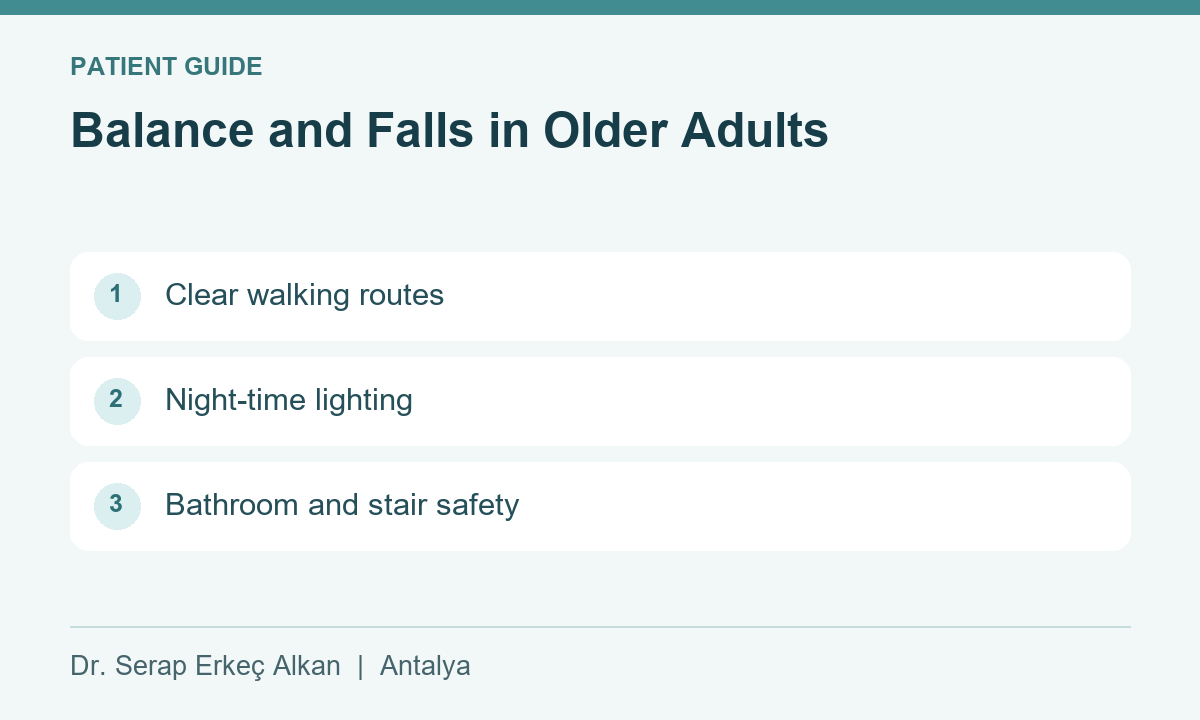
Balance problems and repeated falls should not be dismissed as an inevitable part of ageing. Alongside small changes at home, understanding when and how a fall occurred is important. This guide helps families in Antalya and the Muğla area prepare while respecting the person’s independence.
Write down the fall history together
Falls can involve muscle weakness, balance or vision problems, medicines and environmental obstacles. The circumstances matter as much as the number of falls. ‘I tripped’, ‘I felt dizzy’ and ‘my leg gave way’ describe different experiences. Record the person’s own account.
Review the home room by room
Check regularly used routes, from the entrance to the bedroom. Identify cables, loose rugs, narrow passages and poor lighting. Put commonly used items where they do not require stretching or unstable climbing. Ask about suitable bathroom and stair supports. Agree changes with the person instead of abruptly changing familiar arrangements.
Consider night-time needs separately
Check the route to the toilet at night. Is the light switch reachable? Is the route clear? Is the walking aid accessible when needed? Keep a phone or means of calling for help within reach. The aim is to make appropriate assistance available, rather than prevent all movement.
How can family help?
Listen to the activities the person wants to do. Taking over every task can undermine independence. Clarify with the assessment team which activities need help and which can be done safely. Bring a current medication list and do not stop medicines independently. Avoid unsupervised tests that risk a fall, such as standing on one leg.
After a fall
Get emergency help if a head, neck, back or hip injury is suspected, or if the person cannot get up. Do not force someone up when injury is possible. Recurrent falls and new walking difficulties warrant assessment. Vision, hearing, medicines and mobility may need to be reviewed together.
Preparing for assessment in Antalya
List recent falls, locations and symptoms afterwards. If using photographs of the home, remove private information from view. Plan a companion, getting out of the vehicle and walking support. Write down goals such as shopping again or moving around the home more confidently. Discuss who will provide any support after the assessment.
Frequently asked questions
Are falls unavoidable in older age?
No. Repeated falls and modifiable risks should be assessed.
Should we carry out balance tests at home?
Avoid unsupervised tests that could cause a fall. Arrange suitable assessment with a healthcare professional.
See our rehabilitation information and contact page.
Publisher: Dr Serap Erkeç Alkan Clinic. This article provides general information and does not replace an individual diagnosis or treatment plan. Treatment decisions require a clinical assessment.

