
Radiofrequency Ablation for Neck Pain and Facet-Related Headache

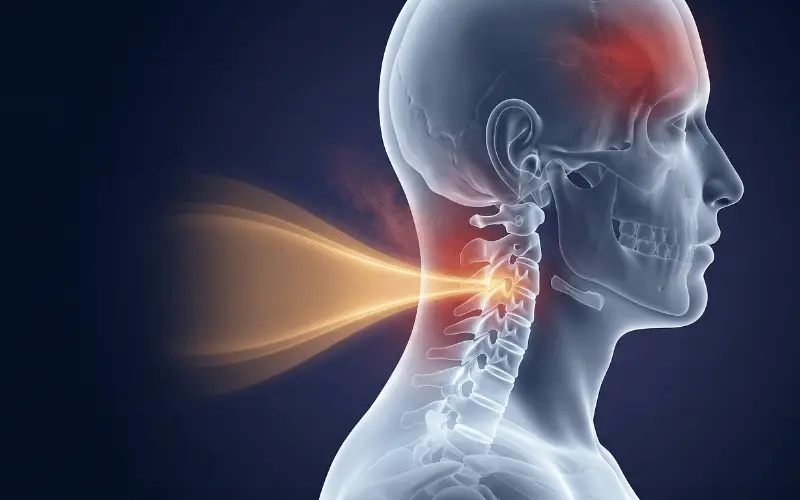
Persistent neck pain and headaches can have several causes. Long periods at a desk or using a phone may aggravate symptoms, but posture or a straightened neck curve on a scan does not, by itself, identify the source of pain.
For selected patients with pain arising from the cervical facet joints, radiofrequency ablation may be considered after assessment and appropriate non-invasive treatment. It aims to reduce pain signalling; it does not rebuild a joint or guarantee a permanent cure.
Neck posture and the cervical spine
The cervical spine supports the head and allows movement while protecting the spinal cord. Its usual curve is called cervical lordosis. The appearance of this curve varies with positioning and individual anatomy. A report of reduced lordosis should be interpreted alongside symptoms and examination.
Sustained positions can contribute to muscle fatigue and discomfort. Frequently quoted calculations of the load from looking down are models, not predictions of inevitable damage. Comfortable workstation adjustments, varied positions and regular movement are practical starting points.
What are the facet joints?
Facet joints are small paired joints at the back of the spine. They guide movement and have cartilage, a capsule and a nerve supply. Age-related changes may be seen on imaging in people with or without pain.
Facet-related pain may be felt in the neck, shoulder region or head. Certain movements can provoke it, but these symptoms are not specific enough to confirm the diagnosis. Arm tingling, weakness or other neurological symptoms need assessment for possible nerve involvement.
How can neck pain be associated with headache?
Signals from the upper neck and the trigeminal sensory system converge in pathways often described as the trigeminocervical complex. This helps explain why pain from some neck structures may be referred to the head.
A cervicogenic headache is different from migraine, although symptoms can overlap and conditions can coexist. Neither a neck scan nor the location of pain alone settles the diagnosis. Migraine has its own acute and preventive treatment options; see information about botulinum toxin for chronic migraine.
Assessment and diagnostic medial branch blocks
Assessment includes the headache and neck-pain history, examination, previous treatments and any indications for imaging. Scans can identify structural changes, but cannot reliably show which structure is painful.
A medial branch block places local anaesthetic near the small nerves supplying a suspected facet joint. A temporary reduction in the usual pain can support treatment selection. Blocks have limitations, including false-positive and false-negative responses; a positive result is not a guarantee that ablation will work. The number of blocks and response criteria depend on the clinical protocol.
What happens during radiofrequency ablation?
Conventional thermal radiofrequency treatment uses energy delivered through a specialised needle to create a controlled lesion near a target nerve. For facet pain, the target is typically a medial branch. Pulsed radiofrequency is a different technique and should not be treated as interchangeable.
The clinician uses appropriate imaging guidance and may perform stimulation tests before treatment. Local anaesthesia and, in some settings, sedation are used. The procedure and discharge arrangements vary; ask about fasting, medication instructions, transport and whether an escort is needed.
Benefits and limitations
Some carefully selected patients experience reduced pain and better function for a period after treatment. Others obtain little or no benefit. Relief may wear off as nerves recover, and repeat treatment requires reassessment rather than an automatic schedule.
Radiofrequency treatment does not reverse osteoarthritis, correct every change in spinal alignment or treat every type of headache. Published success rates vary with patient selection, technique and the definition of success; they cannot predict an individual’s outcome.
Risks that should be discussed
Temporary soreness, numbness or an altered sensation can occur. Other risks include bleeding, infection, nerve irritation and injury to nearby structures. Serious neurological complications are uncommon but must not be described as impossible. The small target nerves also have functions beyond simply transmitting joint pain.
Tell the clinician about anticoagulants, allergies, implanted devices and relevant medical conditions. Never stop prescribed medication without individual instructions. Seek urgent help for new marked weakness, difficulty walking, bladder or bowel changes or severe unexpected symptoms after a procedure.
Rehabilitation after treatment
If pain improves, the opportunity can be used to rebuild movement confidence, strength and tolerance for daily activities. A tailored programme may include neck and shoulder exercise, activity pacing and workstation changes. Additional injections are not automatically necessary.
See orthopaedic rehabilitation and our cervical disc information for related topics.
Frequently asked questions
Is an overnight hospital stay needed?
Many procedures are performed as day cases, but the setting and discharge plan depend on individual circumstances.
Does a straightened neck curve mean I need ablation?
No. Treatment requires an assessment of the likely pain source and suitable alternatives.
Is facet arthritis the same as a disc herniation?
No. They involve different structures, although they may coexist. A disc problem can irritate a nerve root; facet pain is assessed differently.
Will relief be permanent?
Permanent relief cannot be promised. Agree goals and follow-up measures before deciding on treatment.
Read about radiofrequency ablation or contact the clinic in Antalya for an assessment enquiry.
Publisher: Dr Serap Erkeç Alkan Clinic. This article provides general information and does not replace an individual diagnosis or treatment plan. Treatment decisions require a clinical assessment.

