
Lumbar Disc Herniation: Non-Surgical Care and Rehabilitation in Antalya

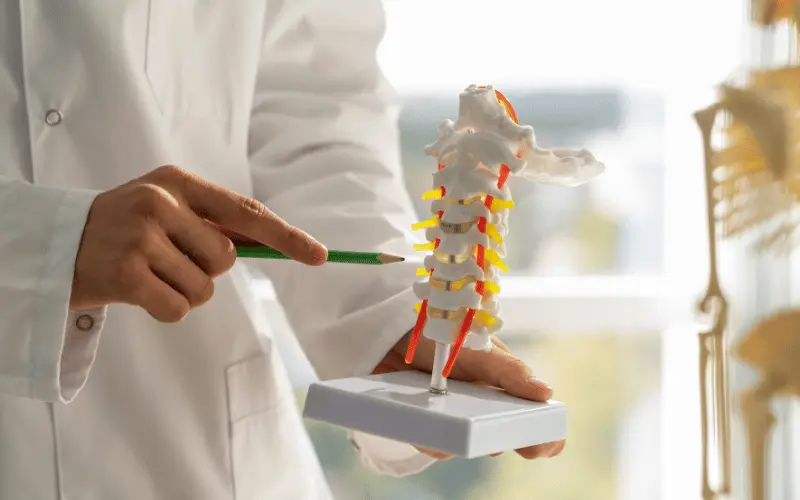
Lumbar disc herniation can affect comfort, walking, sleep and work. A useful treatment plan considers symptoms and function alongside the scan, rather than focusing only on the disc image. At an assessment in Antalya, previous treatment, neurological findings and personal goals help determine which options are appropriate.
What happens in a disc herniation?
An intervertebral disc has a tougher outer ring, the annulus fibrosus, and a softer centre, the nucleus pulposus. When disc material extends beyond its usual position, it can irritate or compress a nerve root. Pain may spread into a leg, with numbness, tingling or weakness. Inflammation around the nerve can also contribute.
Many people improve with non-surgical care, although surgery may be necessary in selected cases. A scan description alone does not determine the plan. Bulging, protrusion, extrusion and sequestration describe different appearances; they should not be matched automatically to a particular injection.
Start with assessment and an individual plan
The examination may assess strength, sensation, reflexes and movement. Treatment choices depend on the duration and severity of symptoms, function, previous care and any urgent features. Education, appropriate activity, exercise and medicines may form part of care. Selected procedures or surgical referral are considered according to the clinical situation.
New bladder or bowel control changes, loss of sensation around the genitals or rapidly worsening weakness require urgent medical assessment. Do not wait for a routine rehabilitation appointment.
Neural therapy: questions about the proposed role
Neural therapy uses local anaesthetic injections at selected sites. Its explanations may refer to autonomic regulation or ‘interference fields’, such as scars. These concepts do not prove the source of back pain or that a nervous-system ‘reset’ has occurred.
If recommended, ask what symptom is targeted, what evidence supports its use for your diagnosis and how response will be assessed. Previous scars or dental problems should not automatically be treated as the cause of disc-related pain. See neural therapy information.
Prolotherapy and structural claims
Prolotherapy generally involves injecting a dextrose-containing solution into selected tissues. Proposed mechanisms describe an inflammatory response followed by collagen production and remodelling. Studying these processes does not establish that a disc tear will heal, ligaments will strengthen sufficiently to relieve nerve pressure or surgery will be avoided.
Prolotherapy and corticosteroid injections have different proposed purposes and evidence. Neither can be judged by a universal session number or duration of benefit. Discuss the precise diagnosis, target, alternatives, likely benefit and adverse effects. Laboratory findings, symptom relief and demonstrated structural change are separate outcomes.
PRP: what does the preparation mean?
Platelet-rich plasma is prepared by taking blood and concentrating its platelet-containing fraction, commonly using centrifugation. Platelets contain substances involved in healing, including growth factors. However, that biological role does not demonstrate that an injection will repair a lumbar disc or reverse degeneration.
Preparation methods, injection targets and clinical evidence vary. Ask specifically about evidence for the proposed spinal application, rather than assuming results from knee or tendon research apply. Benefit may be delayed, limited or absent, and an individual review plan is needed.
Radiofrequency procedures
Radiofrequency treatment refers to several techniques used for selected pain conditions. Conventional thermal procedures and pulsed techniques differ in their effects and targets. Facet-joint pain and nerve-root pain are not interchangeable diagnoses.
These procedures do not remove a herniated disc. The exact technique, role of diagnostic blocks, evidence, setting, anaesthesia and recovery instructions should be discussed with the treating team. A lower-temperature technique is not automatically free of nerve or other procedural risks.
Mesotherapy and dry needling
Mesotherapy uses small superficial injections of selected substances. It should not be assumed to deliver medicine directly to a disc or avoid all systemic adverse effects. Ask whether it is proposed for an associated pain complaint and what evidence supports that use.
Dry needling may be considered for selected muscle-related symptoms. It does not remove nerve compression or guarantee immediate improvement. Medicine-free needling still has potential adverse effects.
The role of rehabilitation
Rehabilitation supports movement, strength, confidence and daily function. A programme may combine graded activity, trunk and lower-limb strengthening, movement practice and education. It should be adjusted to symptoms and progress rather than offered as an identical course for everyone.
Orthopaedic rehabilitation addresses musculoskeletal capacity, while relevant neurological deficits may require additional assessment and coordinated care. Sports rehabilitation adds sport-specific demands when return to training is a goal. Spinal cord injury and cerebral palsy are separate clinical situations with their own rehabilitation needs; they should not be treated as interchangeable with routine disc-related back pain.
Choosing a service
Ask about the clinician’s relevant qualifications, the assessment process, coordination with other professionals and how the plan will be reviewed. Availability of a device or injection does not establish that you need it. A clear explanation of alternatives and expected outcomes is more useful than a fixed package of sessions.
Technology in rehabilitation
Digital exercise support, remote follow-up, virtual environments and robotic systems may have roles in particular rehabilitation settings. They do not guarantee faster recovery or error-free movement. Their suitability and actual availability should be confirmed. For many patients, a practical exercise plan and appropriate follow-up remain central.
Daily life after treatment
Review prolonged sitting and arrange opportunities to change position. Choose supports and sleeping positions according to comfort and individual advice. When lifting, consider the weight, your capacity and a manageable technique rather than forcing a painful movement.
Discuss nutrition, general health and lifestyle where relevant. Drinking more water or taking supplements does not replace treatment for disc-related symptoms. Supplements should be reviewed alongside medical conditions and medicines.
Travelling to Antalya for care
Plan assessment, records, transport and follow-up before travelling. A sunny climate does not establish a medical recovery advantage. Surgical decisions depend on symptoms, neurological findings and response to care; combining several procedures cannot guarantee avoidance of surgery.
See our lumbar disc treatment page, international patient information and contact details.
Publisher: Dr Serap Erkeç Alkan Clinic. This article provides general information and does not replace an individual diagnosis or treatment plan. Treatment decisions require a clinical assessment.

